Posted on Leave a comment

On Amazon reviews

As a small business owner who wrote a book I really, really want people to buy, I have a weird relationship with Amazon.  I recognize that people have access to books (like mine) that they wouldn’t even know about because of Amazon’s reach. Amazon also makes it much easier for me to be an independent author.

I also recognize their capitalistic predation that puts small bookstores at risk, and their data center builds that harm the environment. And yes, there is no ethical consumption under capitalism. We all have someone’s hand in our pocket, and the best we can do is try to do the best we can, within our circles of control and influence.

So, while my books are listed on Amazon, I hope you will buy them direct from my website. It will take me longer to ship it than Amazon, but it also means I make literally 3 times as much money when you buy it directly, and I get the money the next day, instead of more than 90 days later. And I assure you, my plans for that money are probably more in line with your values than Jeff Bezos’ plans for it.

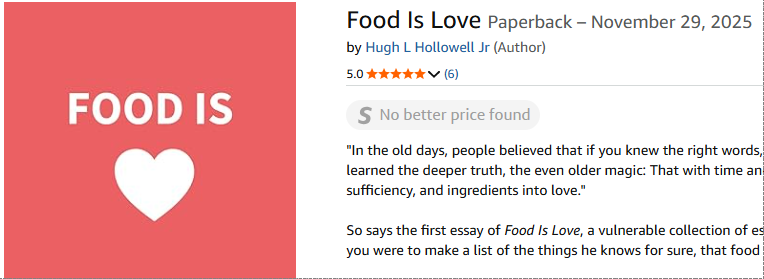
That said, one thing you can do is share a review of the book on Amazon. Reviews give social proof and might tempt a potential buyer to take a chance on an unknown author. Most of the books I buy are purchased elsewhere, but I will almost always check Amazon reviews as part of my buying decision.  I’m not alone in this.

So, if you have purchased Food Is Love, got a free copy of the PDF because you are a member, or even read a borrowed copy, PLEASE leave a review on Amazon or Goodreads, or both. It is a huge help, and dramatically improves the odds of more people reading this book.

Posted on Leave a comment

First post

Hi there. I’m Hugh Hollowell, the proprietor of Canebrake Studio.

Canebrake Studio is the legal entity that “holds” all my creative pursuits. It’s a legal business, and acts as my publishing company, and as the store through which I sell the things I make.

I did it this way for a number of reasons.

One is that it makes taxes simpler. Not cheaper, mind, but simpler. Don’t ask me much about this, as I have no tax advice at all – I can’t even balance my checkbook. Which is why simple works for me.

It also gives me space to talk about the creative projects I’m working on, and the behind the scenes stuff, and all the things that people who follow my writing for other reasons do not care about.

So why the name Canebrake?

Canebrakes are wetland ecosystems in the Southeast US that are made up mostly of river cane, a sort of native bamboo. They are dense and nearly impenetrable, and have historically been the place where the dispossessed have hidden to recuperate and survive. In the aftermath of the Trail of Tears, indigenous Americans hid there; during slavery, escaped enslaved people hid there. Canebrakes seem scary to the privileged, but are places of safety and renewal to the people and ecosystems they seek to harm. Canebrakes are sources of a completely renewable building material we as a society in the US have virtually ignored. Instead, our response to canebrakes is to destroy them.

Safety to the dispossessed. Scary to the powerful. Extremely useful, but largely ignored and even targeted for destruction.

Seems reasonable to me.